The peacoat edit moves from navy history to black, soft neutrals, shorter proportions, and expressive prints. I remain extremely susceptible to a good lapel and a persuasive button.
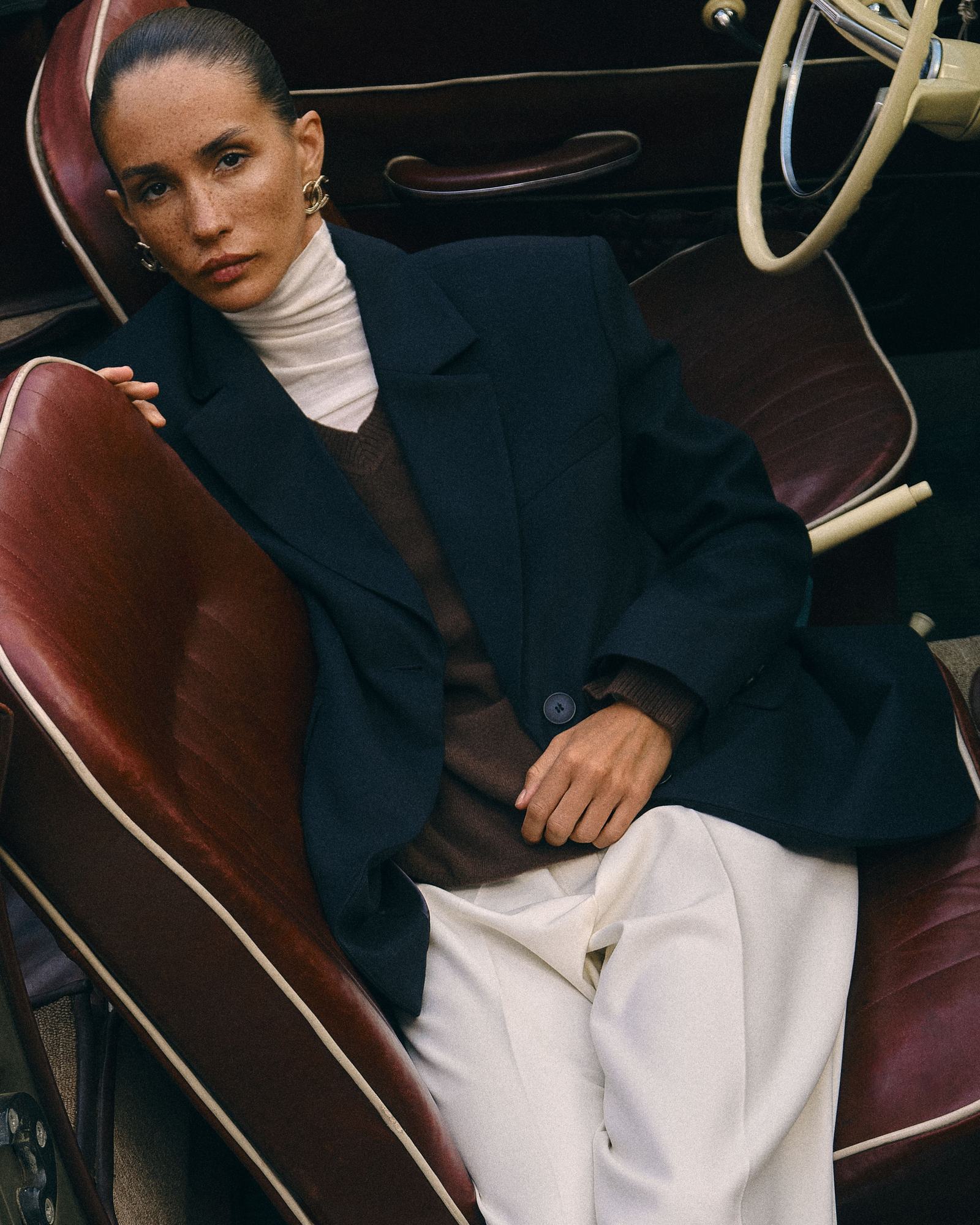
The Peacoat Edit: Five Lessons for Landlubbers With Good Lapels
Confessions of a coat person
I can spot a peacoat from across a crowded sidewalk, then spend approximately four seconds deciding whether it wants denim, a skirt, or the trousers I have not yet pulled from the closet. I keep a private tally of the lapels, the buttons, and whether the sleeves leave room for a ridiculous sweater. I have no shame about this.
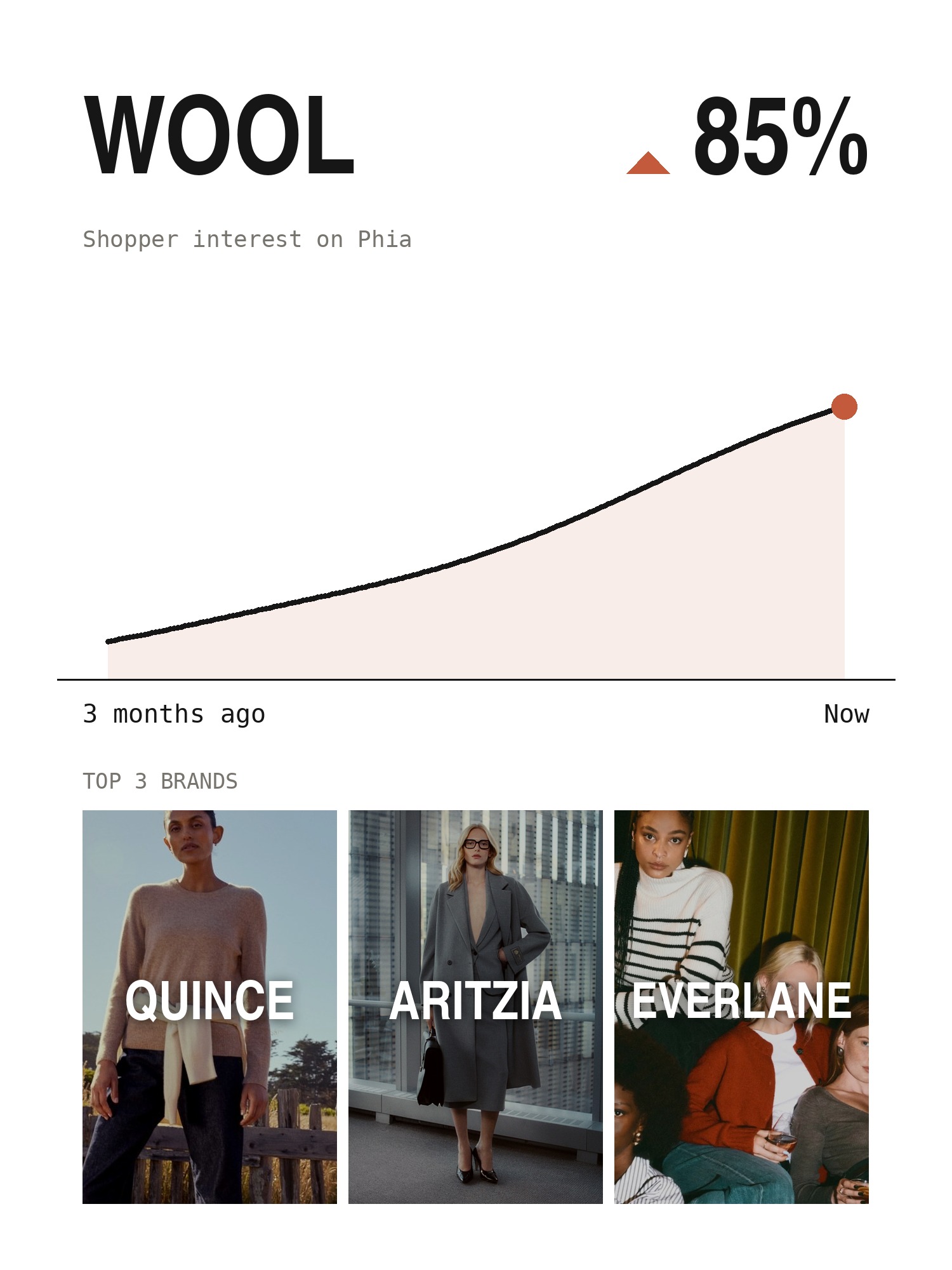
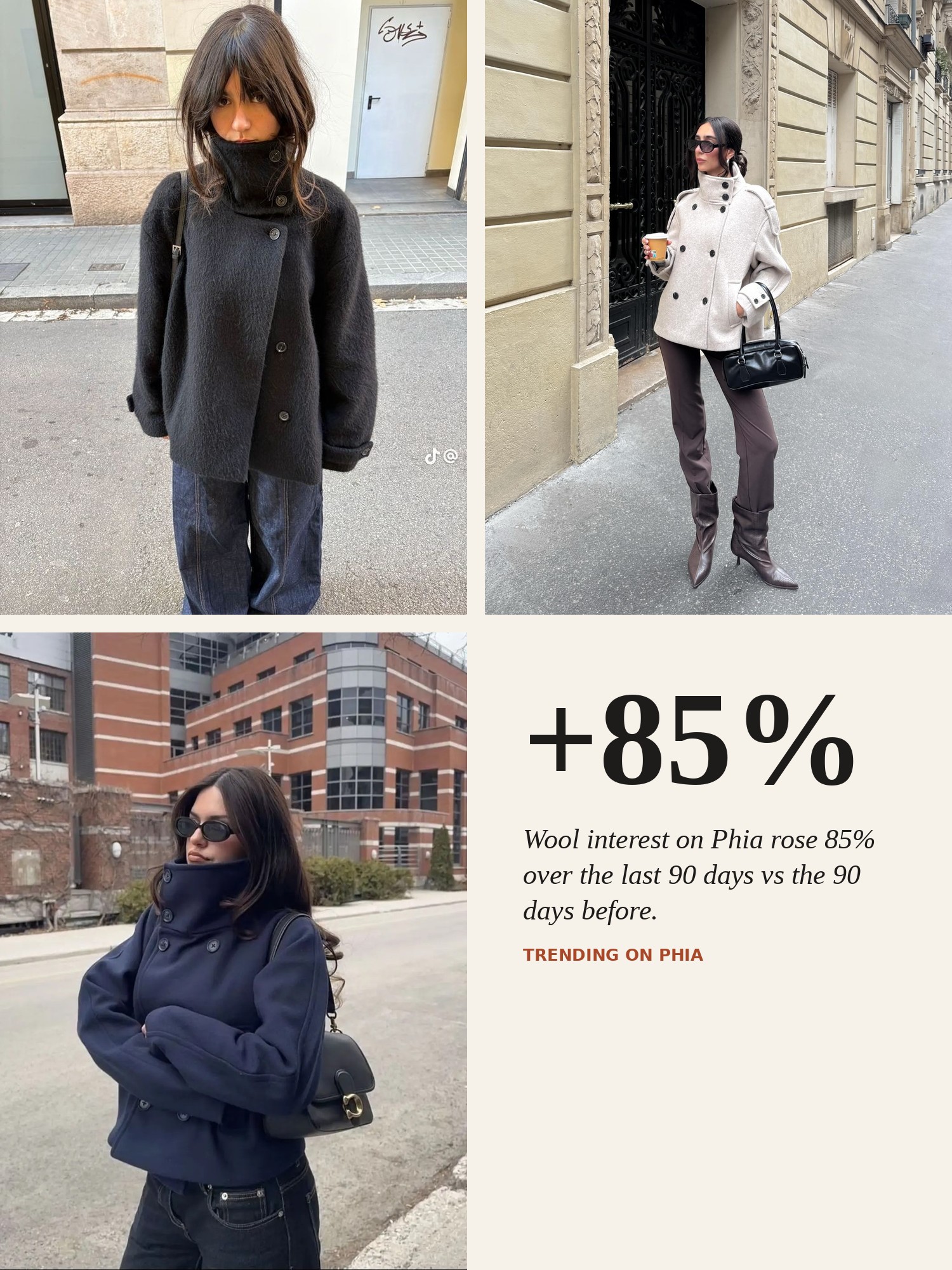
But somewhere between navy uniform nostalgia, wool forecasts, and the pressure to make every coat do absolutely everything, dressing for cold weather has gotten a little complicated. We are told to find one good navy coat and also to consider black, camel, cropped, print, and a different version for every possible self. Apparently one coat needs a larger social calendar than I do. Phia's wool interest rose 85% over the last 90 days versus the 90 days before, while linen fell 65% and cotton fell 23% over the same stretch.
Which brings me to Daniel Roseberry at Schiaparelli's Place Vendôme venue in February 2024. His navy coat became statement outerwear, its buttons spelling the brand name. I like the reminder that a sailor's coat can carry its history and still leave room for a designer's point of view.
Some navy coats make me want a sharper collar. Some shorter shapes remind me that proportion is a personal negotiation. And some patterns make a winter outfit feel less like a sentence with no ending. So, here are five lessons for wearing it with a little more intention and a little less naval pageantry.
1. Navy is a shape before it is a color.
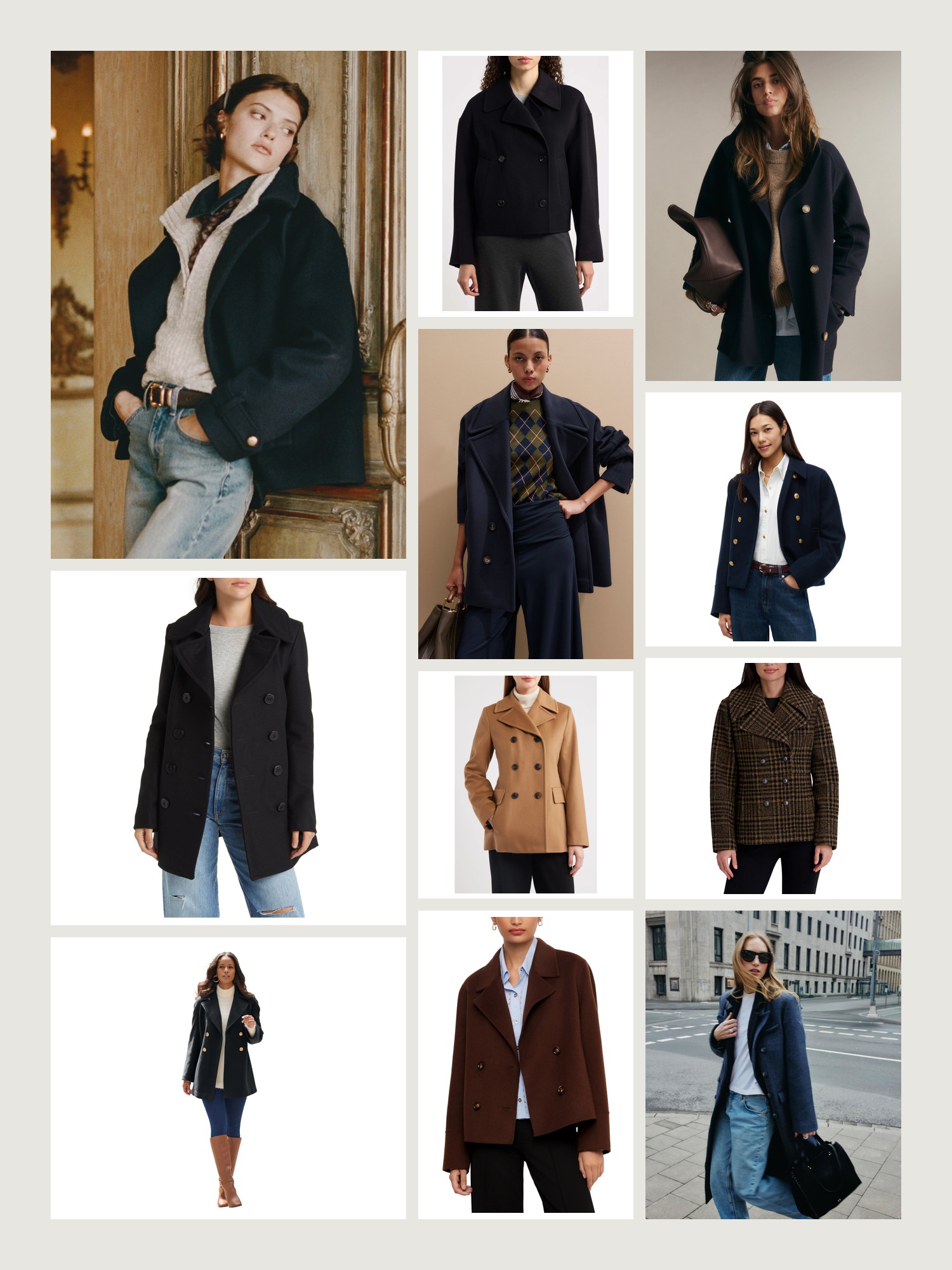
The name has an oddly practical beginning. The Navy Department Library traces pea coat to pilot cloth, a heavy, coarse, stout twilled blue cloth, and notes that the term has been used since 1723. A little history makes the familiar navy silhouette feel less like a default and more like a choice.
The J.Crew Double-Breasted Peacoat in Wool-Blend Melton has broad lapels and six buttons; Schott NYC keeps the front clean with a notched collar; Fleurette Ali adds flap pockets and a back martingale; GANNI Sky Captain gives the dark blue a pleated center back and gold buttons. Belle & Bloom pushes the hem to mid-thigh, while Phase Eight narrows the waist.
My fitting test would be to button the coat over the thickest sweater I actually reach for, then lift both arms as if I were taking a bag from an overhead rack. If the shoulders pull, I would try a roomier cut before blaming the sweater. What I would skip: treating a traditional shape like a uniform you have to obey. Although six buttons are not a dress code.
Navy peacoats

Double-Breasted Peacoat in Wool-Blend Melton
J.Crew
$298

Wool Blend Peacoat
Schott NYC
$560

Ali Wool Peacoat
Fleurette
$599.99

Sky Captain Peacoat Wool Midi Coat
GANNI
$304

Harbour Military Wool Blend Pea Coat
Belle & Bloom
$139.98

Aurelie Wool Peacoat
Phase Eight
$360

Colette Wool Blend Peacoat
Marine Layer
$248

Brushed Wool Blend Peacoat
Karen Kane
$298
2. Black can soften the rules.
A black version is not a break from the coat's history so much as another way to work with its proportions. The Navy's historical survey says the pea coat was first mentioned in regulations in 1841 and became a regular part of the enlisted uniform in 1886. That original purpose was practical; a modern black coat can be a little more personal.
Tuckernuck Black Harley keeps the mid-thigh line and angled flap pockets; Theory's wool blend is shorter at 23 and a half inches and unlined; Belle & Bloom Forget You has a cropped cut and oversized metal buttons. Jessica London's A Line version is 34 inches long, while Roaman's adds a swingy shape and wide raglan sleeves. Central Park West puts a faux-fur collar on its Asher, and Akris punto sharpens the black wool blend with zipped side pockets. Calvin Klein's listed shell is 100% polyester despite the wool-blend name.
I would compare a black coat to the dark shoes and bags already in rotation in daylight, then choose one with a hem that works over the layers I use. Although a black coat can be the most forgiving part of the outfit and still be the thing people notice.
Black peacoats

Black Harley Peacoat
Tuckernuck
$328

Double Breasted Wool Blend Peacoat
Theory
$695

Forget You Military Peacoat
Belle & Bloom
$124.98

A Line Wool Peacoat
Jessica London
$211.16

Plus Size Wool Blend A Line Peacoat
Roaman's
$192.99

Asher Melton Fur Collar Peacoat
Central Park West
$298

Wool Blend Peacoat
Akris punto
$1,690

Wool Blend Peacoat
Calvin Klein
$350
3. Camel and cream need not match everything.
The quietest color in the room can still have a strong point of view. Phia's shopper data shows wool interest rose 85% over the last 90 days versus the 90 days before, which speaks to wool as a category, not camel coats specifically. The neutral group here makes that distinction visible through varied blends and shapes.
Fleurette's Ali Wool Peacoat in camel is 100% wool with six buttons and a back martingale; DKNY's dark-camel version is a lined 29-inch wool blend with zip pockets. GUESS gives ivory a textured finish and mid-thigh line, while Sportscraft keeps its tan coat straight and simple. Anne Klein's camel option uses a pick-stitched trim, and Belle & Bloom's charcoal double-faced coat is unlined. Julia & Stella's taupe jacket adds a detachable hooded bib, so the neckline changes with the weather.
I would test a neutral by holding it next to the jeans, trousers, or scarf it will actually meet, then look for the undertone that feels deliberate rather than accidental. The navy and charcoal options are useful counterpoints if camel feels too close to the rest of the outfit. Although a neutral coat can do the talking without raising its voice.
Camel, cream and classic peacoats

Women's Double-Breasted Long-Sleeve Wool-Blend Peacoat
DKNY
$220.49

Ali Wool Peacoat
Fleurette
$599.99

Leona Wool Blend Peacoat
GUESS
$218

Wool-Blend Pea Coat
Sportscraft
$500

Women's Double-Breasted Peacoat, Created for Macy's
Anne Klein
$139.29

Women's Right and Forward Double Breasted Wool Blend Pea Coat
Belle & Bloom
$195.96

Plus Size Riley Wool Blend Pea Coat
BGSD
$138.6

Women's Double-Breasted Hooded Alpaca-Blend Pea Jacket
Julia & Stella By Maximilian
$781.55
4. A shorter hem changes the whole outfit.
A cropped coat asks the outfit underneath to take a turn. Woolmark recommends a soft brush for woven wool garments, brushing lengthwise after wearing to lift surface soil before it becomes a stain; that small care ritual is useful when a shorter coat keeps landing in the everyday rotation.
FIFTEEN TWENTY Naomi has a boxy cropped shape; GUESS Melissa is a compact 21-and-a-half-inch melton coat with a button-down collar. Belle & Bloom I'm Yours has oversized lapels and novelty buttons, while Tommy Hilfiger American Icons measures 24 inches. Fleurette Jane is 100% wool at 26 and a half inches, and Gallery makes a black-and-white herringbone version with a stand collar.
My practical test would be to sit, reach, and raise both arms while wearing the trousers or skirt I plan to pair with it. If the hem rides up every time I move, I would try a slightly longer cut. What I would skip: styling a cropped coat with a second strong proportion just because both pieces are interesting on their own. Although the shortest coat can make the longest plan for the morning.
Cropped and short peacoats

Naomi Cropped Peacoat
FIFTEEN TWENTY
$358

Melissa Crop Melton Peacoat
GUESS
$158

I'm Yours Wool Blend Peacoat
Belle & Bloom
$188.96

Petite Double-Breasted Short Faux Sherpa Peacoat
Liverpool Los Angeles
$90.3

American Icons Double-Breasted Wool-Blend Peacoat
Tommy Hilfiger
$300.3

Jane Wool Peacoat
Fleurette
$795

Double Breasted Peacoat
Gallery
$80

Double Breasted Faux Fur Peacoat
Halogen
$169
5. Let the pattern have one conversation.
I like a print best when the rest of the outfit gives it room to speak. Vogue's account of Proenza Schouler's Fall 2024 opening look describes a coat whose fabrication and bands circling the sleeves set it apart from standard-issue military surplus. The detail is a useful reminder that one change in texture or trim can alter the whole reading of a familiar shape.
Tuckernuck's Brushed Wool Harley brings leopard to oversized lapels; Kenneth Cole's plaid version pairs a black-brown pattern with structured shoulders. Avec Les Filles makes houndstooth boxy and adds a back martingale, while Sofia Cashmere uses alpaca and wool for its softly flared houndstooth. The Folk Paisley jacquard coat has whipstitched edges and contrasting lapels; Torrid's Winter Bloom puts a vivid plum color on the double-breasted front. Kensie's rose boucle is nipped at the waist, and GERARD DAREL keeps the print-free navy option for anyone who prefers the gold buttons to carry the detail.
I would test a patterned coat with a solid base and one repeated color, then add a scarf only if it supports rather than competes with the print. Although the loudest coat can make the rest of the closet sound more organized.
Printed and colored peacoats

Leopard Brushed Wool Harley Peacoat
Tuckernuck
$328

Plaid Peacoat
Kenneth Cole
$149.99

Houndstooth Peacoat
Avec Les Filles
$159.99

Houndstooth Alpaca & Wool Blend Peacoat
Sofia Cashmere
$995

Whipstitched Oversized Jacquard Peacoat
Avec Les Filles
$248

Plus Size Double-Breasted Peacoat
Torrid
$125.9

Boucle Peacoat with Gold Accents
Kensie
$99.99

Alis Double Breasted Peacoat
GERARD DAREL
$795
The coat can stay in the conversation.
The five lessons add up to a simple permission slip: keep the naval outline, change the color, shorten the hem, or let a print do the opening monologue. A coat can be familiar without being predictable, and practical without making the whole outfit feel like a uniform.
I will still be tempted by an unusually good collar, a shiny button, and a hem that suggests I have a plan. Usually I do not. But there is something reassuring about knowing the coat can make the first impression while I think of one.